
+34 91 532 27 15
Family and possessive adjectives
In this lesson we will learn about possessive adjectives, that are very important elements in all languages. In order to make it more enjoyable, we’ll practice this topic through the vocabulary associated with degrees of relationship in Spanish, because they are used together in most practical situations. Moreover, we’ll extend it through the use of singular and plural.
Please look at this picture and follow the examples below.
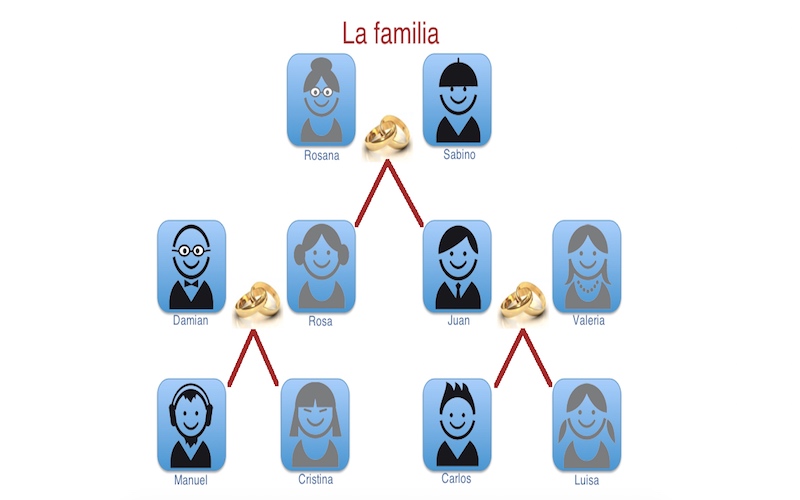
Now compare it with this table. Can you guess who is who?
| Rosana es la abuela de Cristina | Sabino es el abuelo de Luisa |
| Rosa es la madre de Manuel | Juan es el padre de Carlos |
| Rosa es la hemana de Juan | Carlos es el hermano de Luisa |
| Valeria es la mujer de Juan | Damián es el marido de Rosa |
| Rosa es la tía de Carlos | Juan es el tío de Manuel |
| Cristina es la prima de Luisa | Manuel es el primo de Carlos |
| Carlos es el sobrino de Valeria y Juan | Luisa es la sobrina de Damian Y Rosa |
[WpProQuiz 4]
Possessive adjectives: Lesson structure
In Spanish, when we talk about our relatives and relationships, we use the possessive adjectives.
Here are some examples:
Mi hermana vive en Madrid, pero mis padres viven en Barcelona
My sister lives in Madrid but my parents live in Barcelona
¿Tu hijo estudia inglés?
Does your son study English?
¿Tus amigos son franceses?
Are your friends French?
Su marido trabaja en una universidad y sus hijos son estudiantes (de Ana)
Her husband works at the university and her children are students (referring to Ana)
Possessive adjectives are used to express relationship or ownership (your sister, my book, etc.). They agree with the nouns they modify (singular nouns require singular possessive adjectives). In Spanish, adjectives vary if the possessed thing is either singular or plural.
My book = Mi libro (the possessed thing is “book / libro” so “mi” must be singular)
My books = Mis libros (the possessed thing is “books / libros” so “mis” must be plural)
The forms used for a single possessor do not have masculine and feminine forms. They remain the same, regardless of the gender of the nouns they modify.
| Subjects | Singular | Plural | Example in Spanish | Example in English |
|---|---|---|---|---|
| Yo | mi | mis | mi libro/ mis libros | My book/ my books |
| Tú | tu | tus | tu amiga/ tus amigas | your friend/ your friends (female) |
| Él/ Ella/ usted | su | sus | su tío/ sus tíos | your uncle/ your uncles |
| Nosotros | Nuestro (Nuestra) | Nuestros (Nuestras) | nuestro día/ nuestros días | our day/ our days |
| Vosotros | Vuestro (Vuestra) | Vuestros (Vuestras) | vuestra casa/ vuestras casas | Your house/ your houses |
| Ellos/ Ellas/ Ustedes | su | sus | su ciudad/ sus ciudades | your city/ your cities |
Note: In Spanish we do not use the genitive case like in English. We never say: Marta’s hija for Marta’s daughter. The correct form is la hija de Marta.
More grammar: singular and plural
Sometimes families are quite big, so we need to know how to use singular and plural in Spanish, if that is our case!
As in English, Spanish nouns can be singular o plural depending on the number of items we are talking about.
This is how we convert singular nouns into plural:
| Words ending in… | Plural + | Examples |
|---|---|---|
| -a, -e, -i, -o, -u | s | Libro / Libros |
| -á, -é, -ó | Café / Cafés | |
| -consonante | es | Español / Españoles |
| -í, -ú | Esquí / Esquíes | |
| -z | ces | Lápiz / Lápices |
Some examples:
| La mesa | → | las mesas | El pez | → | los peces |
| El libro | → | los libros | La clase | → | las clases |
| El profesor | → | los profesores | El bar | → | los bares |
| El pasaporte | → | los pasaportes | El actor | → | los actores |
| La televisión | → | las televisiones | La canción | → | las canciones |
| El lápiz | → | los lápices | El país | → | los países |
| La ciudad | → | las ciudades | El papel | → | los papeles |
[WpProQuiz 5]
Vocabulary: family
| Español | English |
|---|---|
| Abuela | Grandmother |
| Abuelita | Grandma |
| Abuelito | Grandad |
| Abuelo | Grandfather |
| Abuelos | Grandparents |
| Adoptado | Adopted |
| Amigo/a | Friend |
| Amistad | Friendship |
| Amor fraternal | Brotherly love |
| Antepasados | Ancestors , Forebears , Forefathers |
 WhatsApp